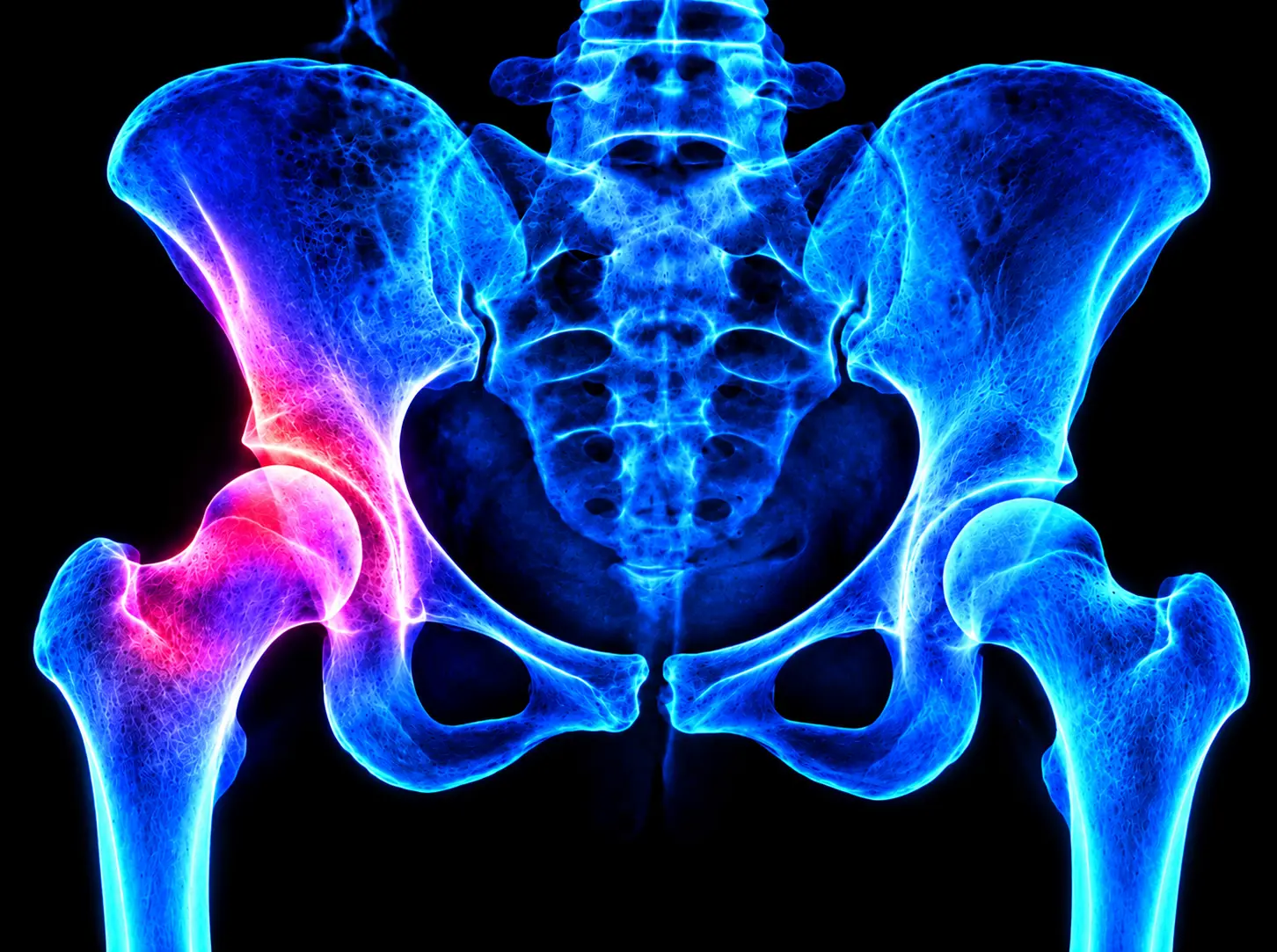
Osteoarthritis in hip dysplasia
In dysplasia the socket is shallow and does not cover the femoral head sufficiently. Depending on severity, the head still sits in the socket, has partly migrated out of it, or has formed a new, false joint above.
- Dysplasia and deep subluxation: The femoral head has partly migrated out of the socket. We place the new cup at the original, anatomically correct position. If bone is missing in the acetabular roof, we rebuild it with bone from the removed femoral head.
- High hip dislocation: The femoral head stands several centimetres above the actual socket, and muscles, nerves and vessels have shortened over years. The leg cannot be pulled down arbitrarily without endangering the sciatic nerve. We therefore shorten the femur deliberately by a few centimetres below the hip joint (shortening osteotomy). This allows the cup to sit in the right place without overstretching nerves.
Protrusio acetabuli
Here the socket sits too deep and the femoral head has migrated into the pelvis. The socket floor is often very thin. We fill the socket floor with the patient's own bone and place the new cup again in the correct position. This restores the natural centre of rotation of the joint and creates a stable bed for the cup.
Osteoarthritis after injuries (post-traumatic)
After fractures of the acetabulum or the femur, bone and soft tissues are often scarred. Plates or screws are frequently still in place, and bone is missing. Before the operation we rule out an occult infection. We remove obstructive metal, in some cases in a separate procedure beforehand. We bridge bone defects with bone grafting or special cups.
Deformities after diseases and previous operations
After Perthes disease, after slipping of the femoral head growth plate (slipped capital femoral epiphysis) or after earlier realignment operations on the femur or pelvis, the femoral head, neck and femur are often deformed or rotated. Here we choose stems that can anchor independently of the shape of the upper femur. If necessary, we correct the deformity in the same operation.
How we plan
- X-rays and computed tomography (CT) for exact measurement of pelvis and femur
- Three-dimensional planning, where the anatomy allows, carried out with the robotic arm (Mako)
- Selection of implants to match the findings, from the standard replacement to special cups and modular stems
- Provision of bone graft and additional implants so that we can respond to any finding during the operation
What you can expect
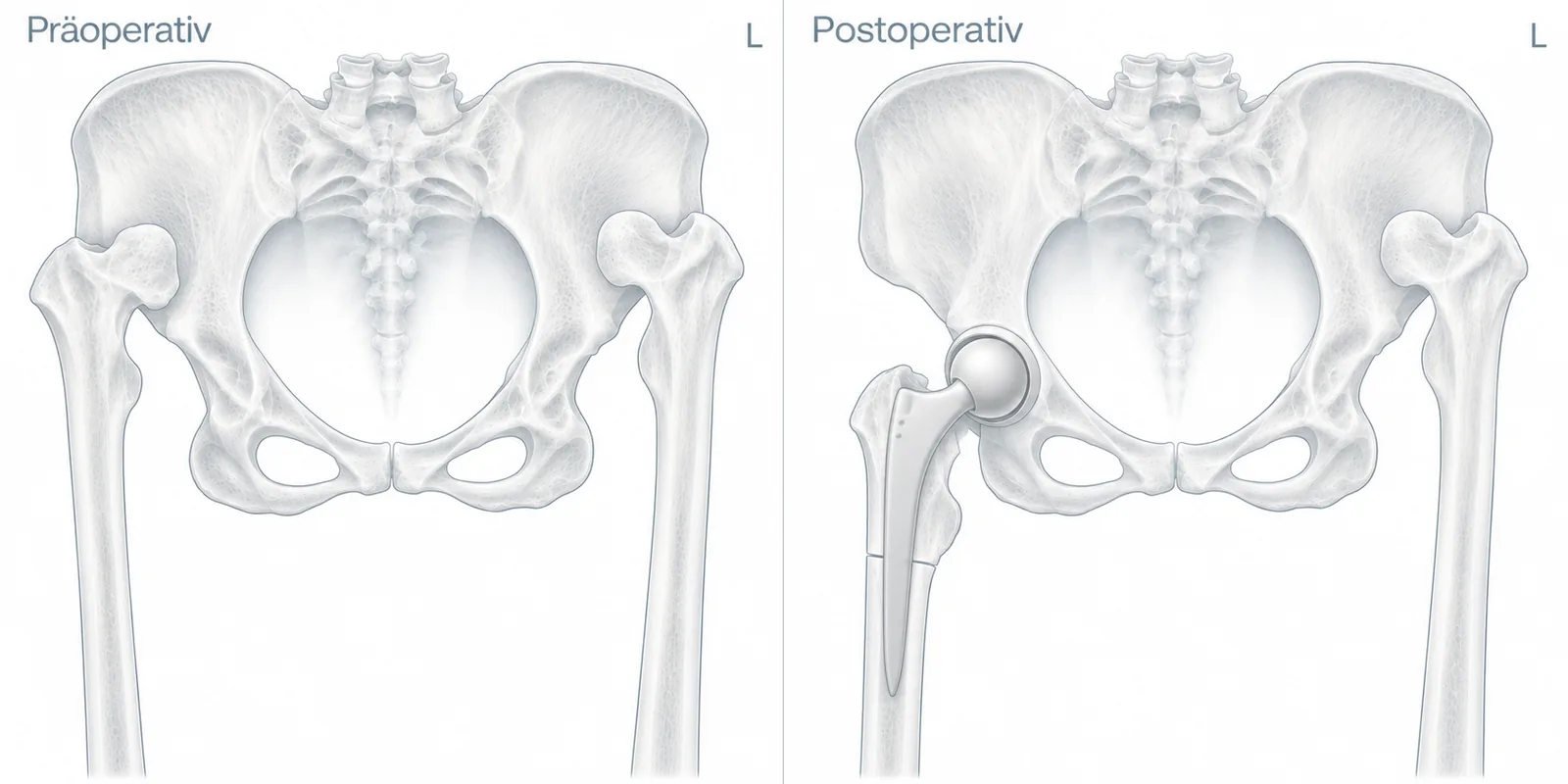
What matters for a durable result is that the cup sits in the anatomically correct position, is firmly anchored in the bone, and that leg length and muscle tension are right. If this succeeds, long-term results are very good even in difficult anatomy. The implant lasts many years, and most patients gain considerably in mobility and quality of life. Many have legs of equal length for the first time in years and walk without a limp.
Honestly, these procedures are more demanding than a standard replacement. The operation takes longer, and the risks, for example of nerve irritation or dislocation, are somewhat higher. After a shortening osteotomy or bone grafting the leg must be partly unloaded for several weeks. Precisely for this reason such operations belong in a centre with extensive experience.
Have your hip assessed. Please bring existing X-rays and CT images as well as reports of previous operations.