What is hip osteoarthritis?
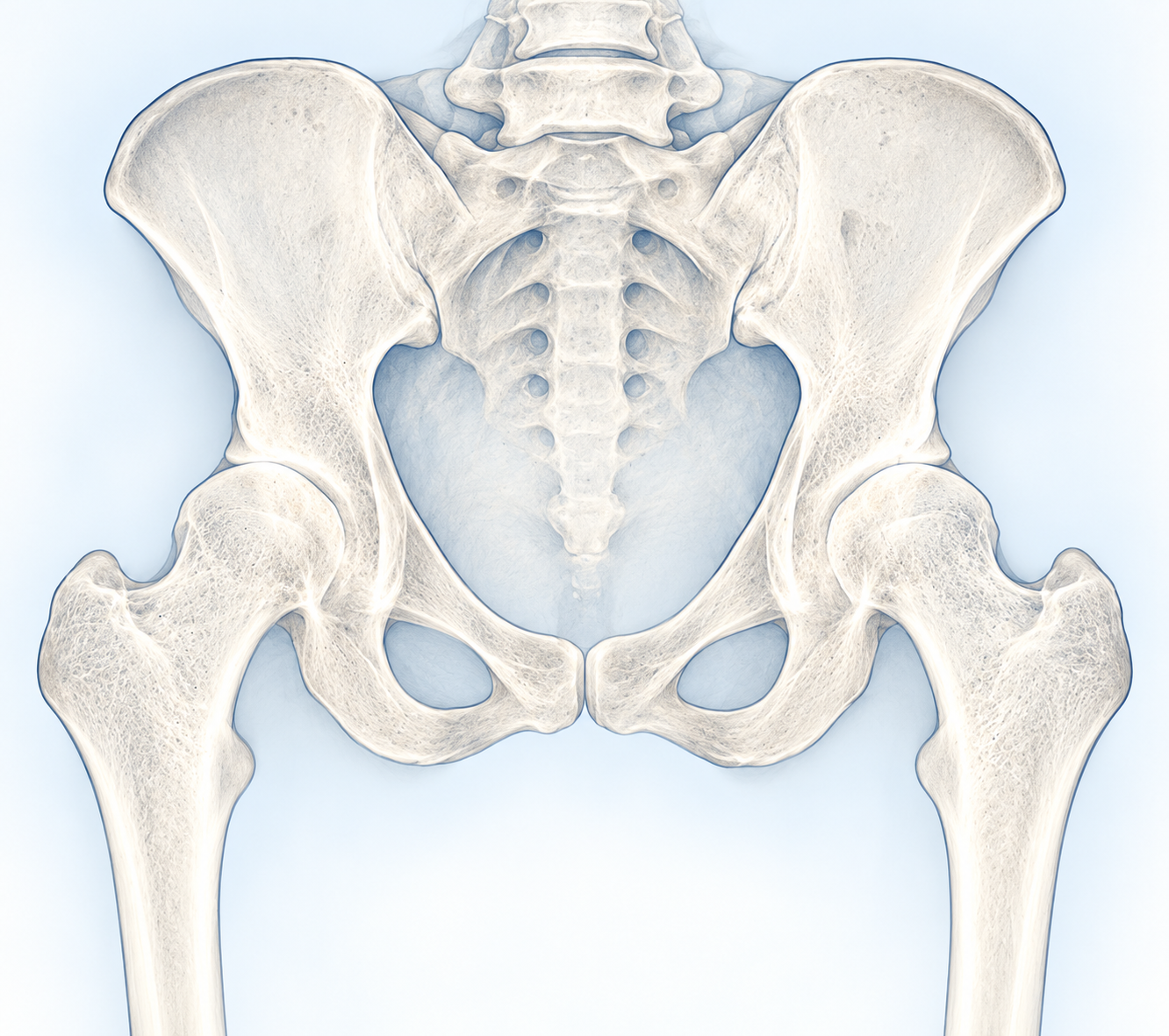
The hip joint consists of the femoral head on the thigh bone and the socket in the pelvis. Both are covered with cartilage – a smooth, elastic gliding layer that lets head and socket move against each other without pain.
In osteoarthritis this cartilage wears away. It first becomes rough, then thinner, and eventually disappears in places. Then bone rubs on bone. The body reacts: the bone beneath the cartilage hardens, bony spurs form at the joint margin, and the joint lining becomes inflamed again and again. The joint becomes painful and stiff.
Osteoarthritis is not simply “wear and tear from age”. It is a disease of the whole joint – cartilage, bone, joint capsule and muscles are all involved.
Causes
Primary osteoarthritis occurs without an identifiable cause, usually from age 50 to 60. Age, genetics and load interact.
Secondary osteoarthritis is the result of another condition. This is common, especially in younger people:
- Hip dysplasia – the socket does not cover the head sufficiently; the rim is overloaded
- Hip impingement (FAI) – head and socket collide during movement and damage cartilage and labrum
- Avascular necrosis – loss of blood supply to the femoral head
- Childhood hip conditions such as Perthes disease or slipped capital femoral epiphysis
- Previous injuries, such as fractures of the socket or femoral neck
- Inflammatory diseases such as rheumatoid arthritis
- Overweight increases load and promotes inflammation in the joint
Important for younger patients: if a shape problem such as dysplasia or impingement is detected early and the cartilage is still good, joint-preserving surgery can often stop or significantly delay osteoarthritis. This is one of our specialities in Greifswald.
Typical symptoms
- Start-up pain – in the morning or after sitting for a while; it improves after a few steps
- Morning stiffness, usually lasting less than an hour
- Groin pain – the typical sign. Pain can radiate into the buttock, thigh and even down to the knee. Some patients are therefore first treated for a knee problem.
- Pain on loading – when walking, climbing stairs, standing for a long time
- Reduced mobility – putting on socks, tying shoes, cutting toenails and getting into a car become difficult. Inward rotation of the leg is usually affected first.
- Shorter walking distance and limping
- Muscle wasting in the thigh and buttock
- in advanced stages, pain at rest and at night, pain when lying on the affected side
Not every hip pain is osteoarthritis. Pain on the outside of the hip often comes from tendons and bursae; pain in the buttock often comes from the lower back. A careful examination is therefore essential.
Diagnosis
- Consultation and examination: we ask about the type, location and duration of pain and your limitations in daily life. Typical findings: inward rotation is painful and flexion is limited.
- X-ray: in most cases an AP pelvis X-ray and a second view of the affected hip are sufficient. These show the joint space as a measure of cartilage, bony spurs and any shape abnormalities.
- MRI or CT – only when needed: we need an MRI if symptoms and X-ray do not match, in younger patients to plan joint-preserving surgery, or if avascular necrosis is suspected.
- Diagnostic injection: if it is unclear whether the pain really comes from the hip, a local anaesthetic injection into the joint can clarify it. If the pain disappears for a few hours, the hip is the cause.
How is osteoarthritis graded?
Doctors usually use the Kellgren and Lawrence classification:
- Grade 0
- no osteoarthritis
- Grade 1
- doubtful, very early changes
- Grade 2
- mild osteoarthritis: small bony spurs
- Grade 3
- moderate osteoarthritis: clearly narrowed joint space
- Grade 4
- severe osteoarthritis: joint space gone, bone deformed
X-ray and symptoms do not always match. Some people with grade 4 cope well, others have considerable pain at grade 2. We treat the person, not the X-ray.
Treatment without surgery
The foundation of all osteoarthritis treatment is conservative care. Current German and international guidelines agree on the key points.
What has been shown to help
Exercise and targeted training are the most important of all. Movement does not “use up” the joint – it nourishes the cartilage and strengthens the muscles that guide and unload it.
- Strengthening of hip and thigh muscles, especially the gluteal muscles
- Endurance with joint-friendly activities: cycling, swimming, aqua jogging, walking, cross-trainer
- Mobility and balance exercises, including tai chi or yoga
- Physiotherapy to learn an exercise programme – which you then continue on your own, long-term
Weight, education and pain medication
Every kilo less reduces the load on the hip during walking several times over. Weight loss has been shown to reduce pain and also lowers the risk if surgery is needed later.
People who understand their condition cope better with it. Education programmes and good patient information are an integral part of the guidelines.
For pain medication:
- Anti-inflammatory painkillers (NSAIDs) such as ibuprofen, diclofenac or naproxen are the most effective – for limited periods, at the lowest effective dose, and with attention to stomach, kidneys, heart and blood pressure. Discuss this with your GP.
- Paracetamol has only a weak effect in osteoarthritis and is no longer recommended as standard.
- Strong painkillers (opioids) are not a long-term solution for osteoarthritis.
Corticosteroid injection into the joint
During a flare-up, a corticosteroid injection into the hip joint – ideally under ultrasound or X-ray guidance – can help considerably for a few weeks. It is not a long-term therapy.
After a corticosteroid injection into the hip, surgery should take place no earlier than 6 weeks, preferably after 3 months – otherwise the risk of infection increases. If surgery is foreseeable, please discuss any injection with us first.
What does not help, or hardly helps
- Hyaluronic acid injections into the hip: in high-quality studies no better than a saline injection. The American guideline explicitly advises against them.
- PRP (platelet-rich plasma) and “stem cell” injections: insufficient evidence of benefit; international guidelines advise against them. They are expensive and self-paid.
- Glucosamine and most dietary supplements: no convincing benefit.
- TENS devices (electrical stimulation): not recommended for hip osteoarthritis.
- Arthroscopy (“joint washout”) in advanced osteoarthritis: it does not address the cause and is not recommended.
We say this openly because we often see patients who have invested a lot of money and time in such treatments.
When does a hip replacement make sense?
Germany has its own S3 guideline on this – the highest quality level for medical guidelines (“Evidence- and consensus-based indication criteria for total hip arthroplasty in hip osteoarthritis”, EKIT-Hip, DGOU 2021). It names three main criteria, all of which should be met:
- 1Clear joint damage on X-ray – moderate or severe osteoarthritis (Kellgren-Lawrence grade 3 or 4).
- 2Conservative treatment has not helped enough – for at least 3 months, combining exercise, education, weight loss if needed, and medication.
- 3High burden of suffering – pain and limitations in daily life clearly reduce your quality of life.
The third point is decisive: it is not the X-ray that decides, but you. There is no “too early” or “too late” by the calendar. Surgery is right when your hip restricts your life more than you are willing to accept.
Your goals count
The guideline recommends that you set your personal goals before surgery – for example walking for an hour without pain, playing with your grandchildren, cycling or playing tennis again. We will discuss honestly with you whether these goals can be achieved with a hip replacement.
Before surgery: reduce risks
Some risks can be significantly reduced before surgery. The guideline recommends:
- Smoking: stop at least 4 weeks before surgery, ideally remain smoke-free until the wound has healed
- Diabetes: good blood sugar control (HbA1c ideally below 8%)
- Overweight: from a BMI of 30, reduce weight beforehand; from a BMI of 40, benefits and risks must be weighed particularly carefully
- Anaemia: test and treat beforehand
- Sources of infection: treat infections of teeth, skin or urinary tract beforehand
It is perfectly fine to postpone surgery to reduce these risks. We will help you.
Which operation is right?
- Joint-preserving surgery – for younger patients with a shape abnormality (dysplasia, impingement) and cartilage that is still good. The aim is to stop the osteoarthritis.
- Total hip replacement – the standard in advanced osteoarthritis. In Greifswald we operate minimally invasively through the anterior approach, without detaching muscles. Where appropriate, we plan and implant with robotic assistance. Our standard is a bone-preserving short stem.
- Ceramic resurfacing – for selected, usually younger and active patients. Only the surfaces of head and socket are replaced; the femoral neck is preserved.
We will decide together which procedure suits your hip.
How good is the result?
Hip replacement is one of the most successful operations in medicine. The vast majority of patients are pain-free or clearly better afterwards, walk without a limp again and return to daily life, work and sport. In most people, modern implants last 20 years and longer.
Your way to us
For an initial assessment we need:
- a current AP pelvis X-ray and a second view of the affected hip
- if available: MRI, doctors’ letters and a list of your previous treatments
Write to me directly: Ortho-terminvergabe@med.uni-greifswald.de. Appointments: Ortho-terminvergabe@med.uni-greifswald.de.
Guidelines and references
- S3 guideline “Evidence- and consensus-based indication criteria for total hip arthroplasty in hip osteoarthritis (EKIT-Hip)”, DGOU, AWMF register no. 187-001, 2021
- S2k guideline hip osteoarthritis, DGOOC, AWMF register no. 033-001, 2019 (under revision)
- Kolasinski SL et al. 2019 American College of Rheumatology/Arthritis Foundation Guideline for the Management of Osteoarthritis of the Hand, Hip, and Knee. Arthritis Care Res 2020